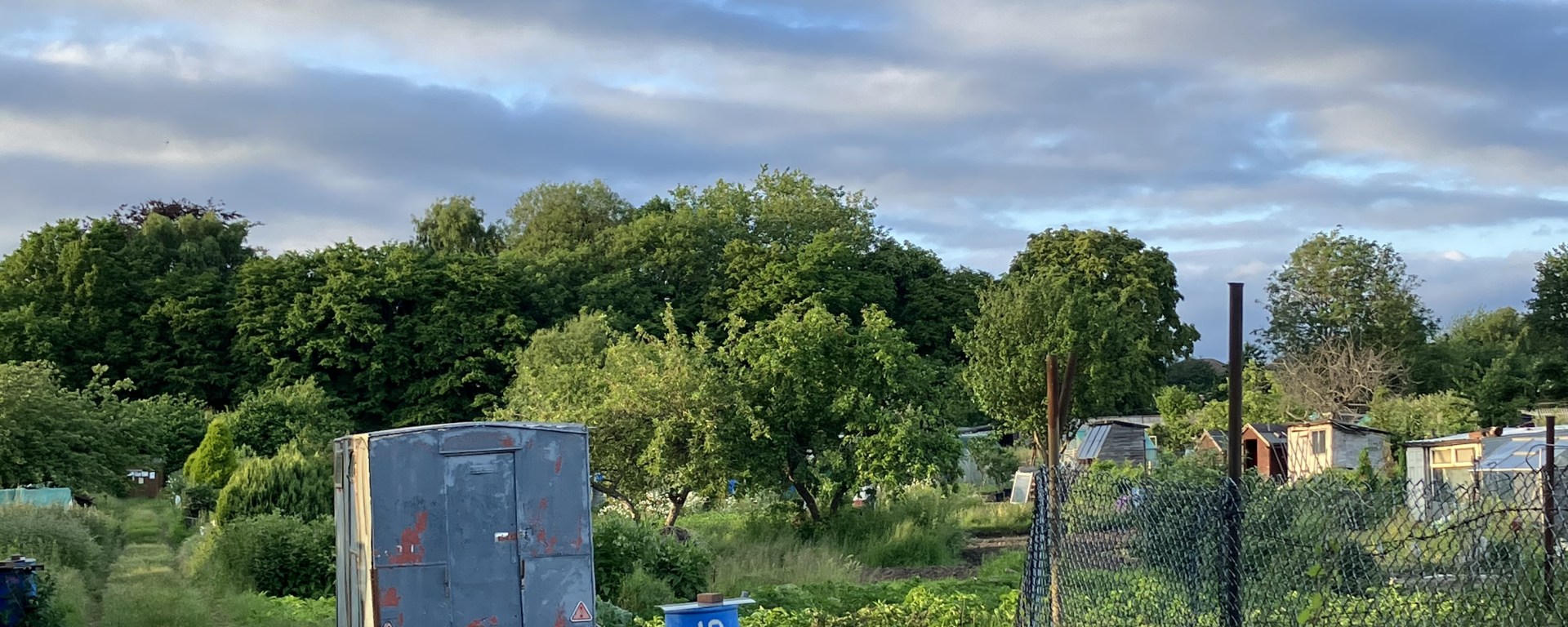
We are a small inner city allotment site (of 40 plots) in Coventry, near to the centre of England, UK. Our site is bordered by a primary school playing field, a row of inter-war terraced houses, a building site (which was until recently the factory where London Hackney Carriages, known as Black Cabs, were built), and a busy arterial route taking traffic to and from Coventry ring road.
We have a serious problem with waterlogging on the lower area of the site, which means that – gradually – as their veg rotted, their backs went and their enthusiasm waned, we have lost plot-holders and been unable to re-let plots in this area. It has also meant, though, that this low-lying area of four plots has begun its own wonderful wilding. Willows and buttercups have moved in and, with them, insects, birds and foxes (who not everyone welcomes, but we are working on it).
Alongside the waterlogging (made worse by the unpredictable weather that climate change brings) we have a lot of plots which don’t prioritise rainwater collection – perhaps because it can be expensive to do, and it might not feel necessary when we have summer access to mains water (although in recent years, we have had to increase rents to cover our rocketing water bills).
We’re really pleased that we have been able to secure an award from the WMCA Community Environment Fund to explore how we might start to address these problems, and the wider issue of future-proofing community food growing on our inner-city allotment.
This blog is integral to the project as a way to record everything (including ongoing impact and evaluation) and to connect, and openly share our experiences; to widen the debate, engage with, and learn from, others doing similar work as we experiment and develop our climate resilience iteratively. We hope it will be a place for conversation.
Like many sites, we have a lengthy waiting list. There’s a massive demand for plots nationally, and for different *kinds* of more accessible plots – that allow people to join a food-growing community with a smaller/more flexible time commitment. This project aims to meet that need, exploring what future community food growing on allotments might look like, building community through learning/sharing adaptable, climate-resilient food production methods, and dealing with the current climate-related waterlogging.
In our experience, shifts in industry, lifestyle, working patterns, economic status and retirement have changed allotment use and relationships between plot-holders. The feeling of community – or collectivism – has suffered onsite as the cohort of people able and willing to volunteer time/labour/expertise has shrunk. Vacant plots rarely become available in good condition now: new tenants often have a daunting clearance job before they can begin to grow – a huge barrier to access which, too often, leads to chemically battling nature, rather than working with it.
We need to learn from best practice growing spaces and fundamentally rethink/test out different models:
-that have the flexibility to accommodate different configurations of gardeners;
-that can support and build a stronger sense of community and collective responsibility/mutual aid;
-that offer communal projects that benefit nature and bring people back together, whilst sharing skills and building resilience to face our uncertain future.
We hope that the legacy of this project will be a strong, stable allotment community, revitalised by different, newly flexible letting configurations and new members. New communal facilities will continue to open up opportunities to gather, to develop/share our climate-resilient practice and to increase engagement with our wider geographical community.
We particularly want to use this project as a way to open the conversation more widely with allotmenteers and food growers across Coventry through the existing forum of the Site Secretaries meetings of the Coventry & District Allotments & Leisure Gardens Council (who manage the city’s 37 sites, approx 2,500 plots, on behalf of Coventry City Council), and in particular with other sites affected by climate-related flooding.
The dream would be to enshrine chemical-free climate-resilient regenerative growing practices within council policy, rolled out across all of the city’s allotments – maybe one day – watch this space, eh?
 Urban Allotment: climate resilience & community
One thought on “All about our project”